
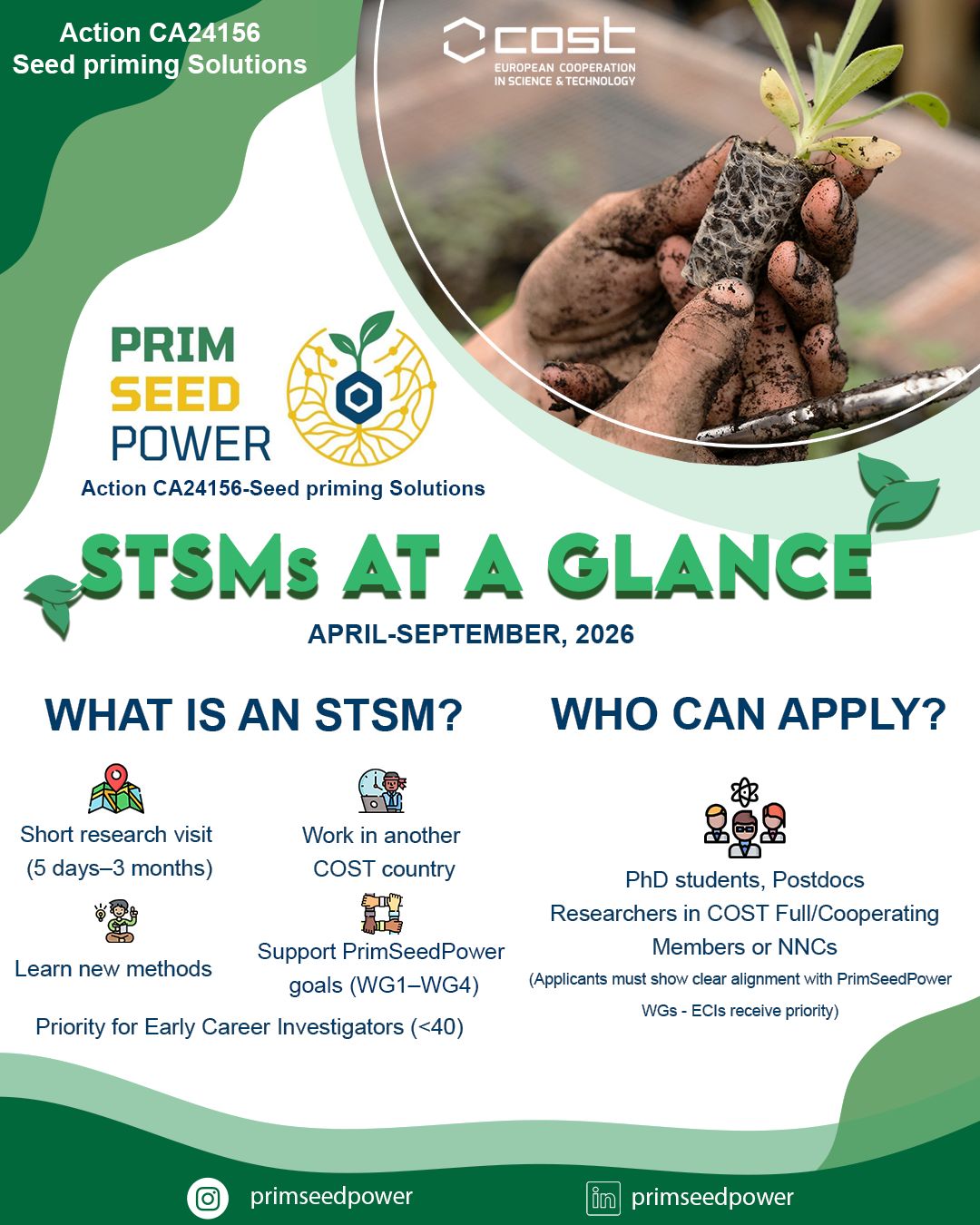
Throughout 2026, PrimSeedPower supported international research exchanges through its Short-Term Scientific Missions (STSMs), connecting researchers with laboratories across Europe to explore new approaches to seed priming, plant stress responses and climate resilience. From molecular modelling and advanced phenotyping to metabolomics and natural priming agents, these missions demonstrated the diversity of expertise within the PrimSeedPower network and the value of working across disciplines and institutions.
The collaborations initiated during the 2026 STSMs provide a foundation for continued scientific exchange, joint research activities and future publications. PrimSeedPower remains committed to supporting research mobility and creating opportunities for researchers, particularly Young Researchers and Innovators, to expand their skills and international networks.
Overview of STSMs awarded in 2026
Click a mission to read the short report.
01 Decoding the seed metabolome with AI and structural biology — Audrey Le Cabec
Audrey Le Cabec
Host: IOCB Prague, Czech Republic | 15 June–15 August 2026
How can we identify the enzymes that make specialized metabolites in seeds? During her STSM, Audrey Le Cabec worked with Dr Tomáš Pluskal’s team on a structure-based computational pipeline focused on flavonol synthase (FLS) homologues. Protein-structure prediction and structural clustering were combined with comparative sequence analysis and leave-one-out validation.
The mission established an initial framework for classifying FLS enzymes and highlighted the need for more experimental functional data. The transferable methods can support future investigations of seed metabolites and their links to stress resilience. Follow-up work includes wider validation and integration with seed metabolomics data.
02 Exploring priming and defence memory in trees and medicinal plants — Nadire Pelin Bahadırlı
Nadire Pelin Bahadırlı
Host: Research laboratory working on Norway spruce
Nadire Pelin Bahadırlı investigated approaches for studying how priming influences later responses to biotic stress. Her experimental training included Norway spruce seedlings pretreated with methyl jasmonate, related signalling compounds, melatonin, chitosan or water, as well as studies involving fenugreek and sumac.
The mobility strengthened skills in phenotyping, RNA isolation and the design of challenge experiments with Botrytis cinerea. Follow-up work will assess disease responses and explore phenolic metabolite profiles, offering a bridge between forest-tree research and medicinal and aromatic plants.
03 Better measurements for plants under stress — Mirza Bakal
Mirza Bakal
Host: Photon Systems Instruments (PSI), Drásov, Czech Republic
Mirza Bakal used advanced plant and algal phenotyping platforms to test and refine methods for tracking photosynthetic performance and tissue thermostability. The work included Chlorella cultures, Norway pine needles, Arabidopsis and fluorescence-based imaging systems.
The mission produced practical methodological insights, including a reproducible configuration for needle thermostability measurements and improved fluorescence-measurement setups. These approaches can support shared protocols and more comparable experimental results across the PrimSeedPower network.
04 How light environments reshape tomato growth — Martina Rosa
Martina Rosa
Host: University of Sarajevo, Bosnia and Herzegovina
Martina Rosa investigated tomato (Micro-Tom) growth under different light environments, including controlled chambers, greenhouses, simulated agrivoltaic shading and open-field conditions. She monitored light availability and plant development to build a comparative experimental dataset.
The work established trials and phenotyping procedures that can support later analyses of physiological and biochemical responses. The cross-institutional collaboration links environmental conditions, plant performance and future research on priming-related adaptation.
05 Designing smarter bacterial consortia for drought biopriming — Marija Anđelković
Marija Anđelković
Host: Prof. Orazio Romeo’s laboratory
Can combinations of beneficial bacteria be selected more rationally for seed biopriming? During a four-week STSM, Marija Anđelković assembled and annotated three tomato-associated bacterial genomes and analysed their taxonomy, gene content and comparative genomic features.
The analysis identified candidate plant-associated functions and a potentially novel Telluria species, which still requires further validation. Genome-scale metabolic modelling was initiated and will continue after the mission to help predict interactions within the synthetic bacterial consortium under drought-related conditions.
06 Bridging physiology and metabolomics in seed priming research — Sanja Ćavar Zeljković
Sanja Ćavar Zeljković
Host: University of Sarajevo, Bosnia and Herzegovina
Sanja Ćavar Zeljković’s mission brought together expertise in metabolomics, analytical chemistry and plant stress physiology. Discussions and joint work connected LC–MS/MS and GC–MS approaches with germination assays, physiological measurements and the interpretation of priming-induced responses.
A central outcome was the structure and work plan for a joint review manuscript on integrating physiological and metabolic evidence in seed priming research. The manuscript remains a planned collaborative output, alongside future experimental and project opportunities.
07 Reading the biochemical signals of crop stress — Eleni Chatzi
Eleni Chatzi
Host: University of Porto, Portugal | 20 August–2 September 2026
Eleni Chatzi received hands-on training in standardized biochemical assays for examining how greenhouse-grown vegetables respond to shading and water deficit. Working with sweet pepper material, she measured oxidative stress and antioxidant defence markers, including MDA, H₂O₂, proline, SOD, CAT and APX, as well as photosynthetic pigments.
The mission completed the planned sweet pepper analyses and strengthened data-interpretation skills. Tomato analyses could not be completed during the visit and were left for follow-up by the host laboratory. The collaboration creates opportunities to transfer the methods to new experiments and researchers.
08 Testing how stress memory may support salt resilience — Maria João da Silva Rodrigues
Maria João da Silva Rodrigues
Host: University of Sarajevo, Bosnia and Herzegovina | 13–17 July 2026
Maria João da Silva Rodrigues explored the experimental design and physiological evaluation of seed priming and stress-memory responses. Alongside practical training in catalase and ascorbate peroxidase assays, the mission included a seedling experiment comparing progenies of differently primed mother plants under control and saline conditions.
Preliminary results pointed to a possible, mother-plant-dependent benefit of the earlier priming treatment for seedling performance under salinity. The findings require validation, while the exchanged methods offer a foundation for further collaboration on stress memory and fungal endophyte-associated priming.
09 Following chemical priming signals from seedling to tree — Sofia Spormann
Sofia Spormann
Host: NIBIO, Norway | Supervisor: Dr Melissa Magerøy
Sofia Spormann examined early biochemical responses of Norway spruce seedlings to seed priming with methyl jasmonate and pipecolic acid. She measured redox and antioxidant indicators, pigments and phenolic compounds in four-week-old seedlings and compared the two signalling treatments.
The early-stage results provide a useful timepoint for interpretation alongside a separate longer-term dataset from one-, two- and three-year-old trees. Follow-up work includes a controlled wounding experiment and joint analysis. These studies can help investigate how priming-associated responses develop over time.
10 Can eucalyptus extracts help tomatoes cope with salt stress? — Helena Mafalda da Costa Pinto
Helena Mafalda da Costa Pinto
Host: Laboratory in Madrid, Spain
Helena Mafalda da Costa Pinto prepared five extracts from Eucalyptus globulus leaves and evaluated them as natural seed-priming agents for tomato. After selecting a salinity treatment for experimental screening, she compared seed germination and early development following priming with different extracts.
The hexane and liquid–liquid fractions showed promising effects on root growth under saline conditions, although germination did not improve consistently. The results support follow-up testing of physiological responses and chemical characterization of the extracts before broader conclusions can be drawn.